
Shipbuilding & Marine
Seawater is nature's toughest electrolyte: roughly 19,000 ppm chloride, plus wet-dry cycling and crevices. The first criterion here isn't strength — it's whether the material can withstand crevice corrosion.
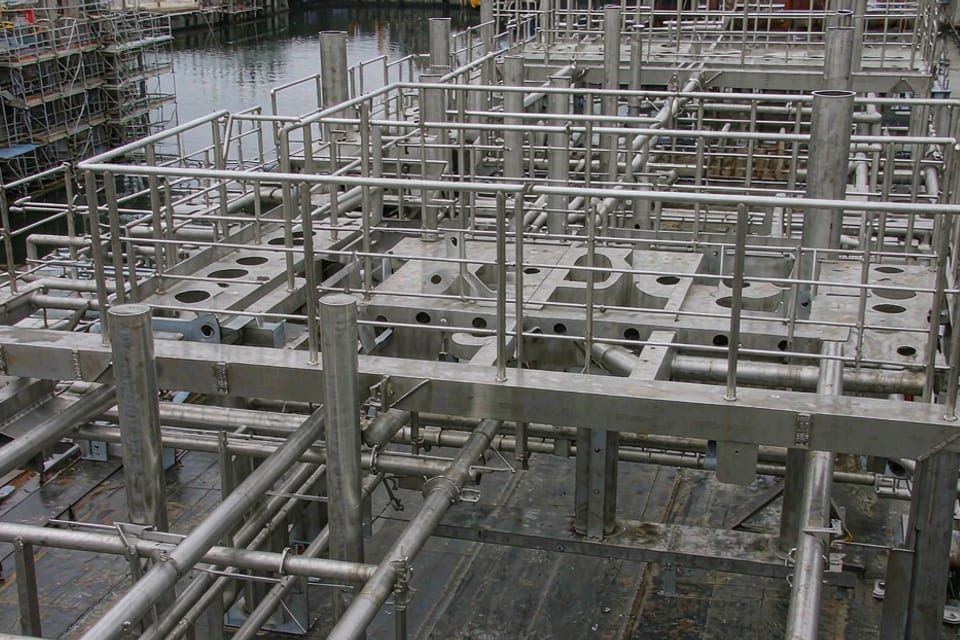
Common Parts & Material Selection
| Part | Grade | Surface / Size | Watch Out For |
|---|---|---|---|
| Floor / Equipment Supports | 316L | Tube / profile, polished | Salt spray mist, post-weld passivation |
| Seawater Pipes | 2205 / 6Mo | Seamless / welded tube | Pitting, flow erosion |
| LNG Tank Inner Lining | 304L / 304 | Plate 8–50 mm | Low-temperature toughness, class approval |
| Galley / Accommodation Equipment | 304 / 316L | 8–2 mm, 2B/HL | Cleanability, fingerprint resistance |
| Fasteners / Fittings | 316 / 2205 | Bar / forging | Stress corrosion cracking |
Three Practical Constraints in This Sector
Crevice corrosion is the dominant failure mode
Under gaskets and at fixture-to-hull contact points, 304 corrodes within months. Design out the crevices (continuous welds, drain holes) and move to 316L or 2205.
Get Class Society Approval Early
DNV / ABS / LR / CCS each maintain their own approved materials list. The best steel grades that aren't yet approved can't pass inspection — check this at the quotation stage.
Welding Distortion Accumulates During Assembly
Thin equipment parts distort and tolerances stack up during final assembly. Pre-fabricate parts with anti-distortion fixtures and allow margin for correction.
Related Products
Need a Quote or Technical Support?
Send us the part, grade, size, quantity, and destination port — we'll respond with FOB / CIF within 24 hours.