
B15 · Housewares & Kitchenware
Stainless Steel Sheets for Kitchenware: 304/201 Selection and Four-Part Checklist
For our kitchenware, we have organized four stainless steel categories: commonly 304 / 201 / 316, thickness from 0.3–5 mm.
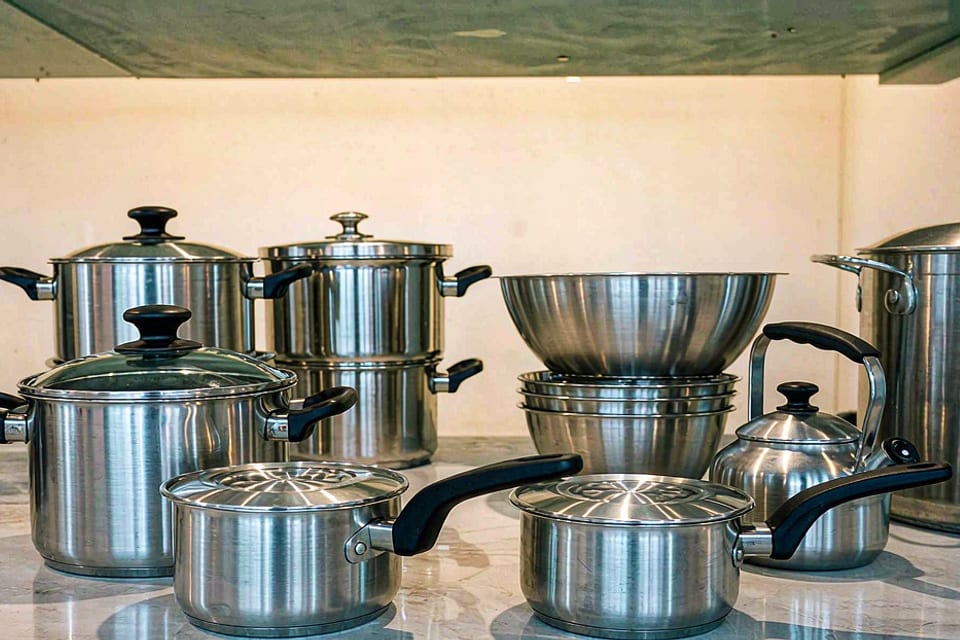
Four Categories and Material Checklist
| Part / Component | Recommended Grade | Size / Thickness | Page | Notes | Standards |
|---|---|---|---|---|---|
| Cookware/Pans/Ceramic Insulators | 304/316/201 | 3–1.2mm | 2B/ Electropolished/Polished | Food contact + Acid + Cleaning + Discoloration during dry burning | GB/T 3280; GB 4806.9 |
| Cutlery/Knife Blades | 420/440 | 1–5mm | Hardening by quenching + Polishing | Edge wear + Chipping + Food acid corrosion | GB/T 1220; GB 4806.9 |
| Hand-wash Sink/Countertop/Splash Guards | 304/201 | 8–3.0mm | 2B/Brushed/Coated | Moisture + Dish soap + Scratches + Food contact | GB/T 3280; GB 4806.9 |
| Material Selection Recommendations | 304/201 | 5–2.0mm | Mirror/Satin/Gold | Moisture + Soap solution + Limescale + Hand sweat | GB/T 3280 |
Interior FromStandard ConfigurationPopular Grades: 304 (3), 201 (3), 316 (1)
Material Type
- 304, 201, 316
- In acidic environments, 316L is preferred; as concentration and temperature increase, 904L / duplex steel may be considered (2/4 points).
- Thickness range 0.3–5 mm: thin sheet for formed products (springback in bending and cracking in deep drawing must be considered), thick sheet for welded structures (heat input and sensitization must be considered).
Frequently Asked Questions
Which stainless steel is most commonly used for housewares and kitchenware?
By total page count, the top 4 are: 304 (3), 201 (3), 316 (1). For specific parts, environment and temperature must be considered; for example, a stainless steel countertop exposed to salt water should use 316L.
Which part is the most challenging?
Failure description, typically for "pots/bowls/thermoses": food contact + salt/acid + washing + dry burning causes discoloration; recommended grades 304 / 316 / 201, thickness 0.3–1.2mm. In this case, it is recommended to define medium concentration, temperature and washing method at the design stage.
Which thickness should be selected?
The list covers thickness from 0.3–5 mm. For thin sheets, bending and surface treatment must be considered; for thick sheets, welding and structural strength must be considered. At the same location, different equipment manufacturers may provide different figures; please check the drawing or operating conditions.
Related Materials and Adjacent Industries
Conditions Similar to Project Deliveries
Tank and Kitchenware Manufacturing
304 / 201 Stainless Steel Coils, Thickness 0.4–3.0 mm
Deep drawing grade, surface finish: 2B and BA, diameter and weight according to order
Applications4
Thickness0.3–5mm